

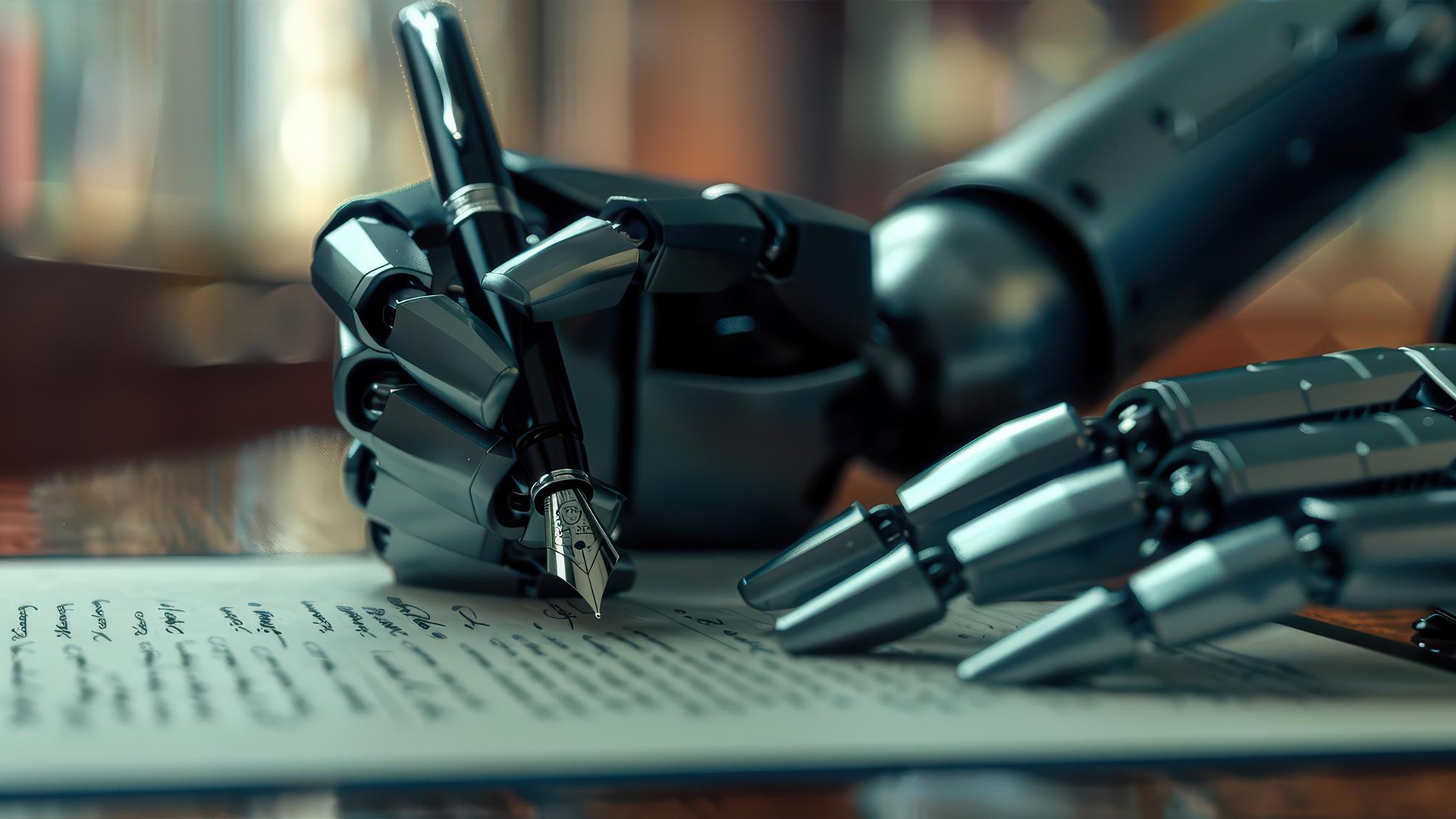
Writers are using AI tools more than ever. Some use them to brainstorm chapter ideas. Some use them to organize messy notes. Some use them to edit sentences, test titles, create blurbs, or outline a book before writing the first page.
This has created one important question for authors: can you use AI to write a book and still own the copyright?
The answer is not as simple as yes or no. AI book copyright depends on how the author used AI, how much human creativity appears in the final manuscript, and whether the author controlled the actual expression of the book.
AI can support the writing process, but copyright is still built around human authorship. If a writer uses AI as a tool while making the creative decisions, the book may still include protectable human work. But if a book is mostly raw AI-generated text with little meaningful human input, the copyright claim becomes much weaker.
For authors, the safest approach is clear: keep the book human-led, document the writing process, and understand the difference between AI assistance and AI authorship.
Why AI Book Copyright Has Become a Serious Question
AI Tools Are Now Part of Many Writing Workflows
AI tools are no longer used only for experiments. Many authors now use them while planning, drafting, revising, and marketing books. A writer might ask AI for chapter ideas, character names, scene prompts, research questions, or reader objections.
This does not automatically mean the book loses copyright protection. The concern begins when AI creates the actual material that appears in the final book with little human rewriting or creative control.
That is why AI book copyright has become a serious publishing issue.
Copyright Law Still Focuses on Human Authorship
Copyright protects original human expression. It does not protect a general idea, a simple concept, or machine-generated output with no human creative contribution.
For books, this means the human author’s role matters. Did the author write the final sentences? Did they shape the structure? Did they choose the examples, scenes, voice, and argument? Did they revise the material in a meaningful way?
Those questions matter more than whether AI was used at all.
Authors Need to Separate Writing Help From Authorship
Using AI for help is different from letting AI become the author.
A tool can suggest ideas, organize notes, or point out unclear sentences. But the author should still decide what the book says, how it sounds, what it includes, and how the final manuscript reads.
That difference is central to AI book copyright.
The Simple Answer: Can You Own Copyright in an AI-Assisted Book?
Yes, If the Human Author Created the Original Expression
An author may still own copyright in the parts of a book they personally created. This includes original wording, structure, characters, arguments, examples, scenes, explanations, and creative arrangement.
If AI helped with brainstorming or editing, but the author wrote and shaped the final work, the author’s human expression may still be protected.
The key point is creative control. The more the final book reflects the author’s own decisions, the stronger the claim.
No, Not for Pure AI-Generated Text Alone
If AI creates full chapters, paragraphs, poems, stories, or explanations and the author publishes them with little change, those parts may not qualify as human-authored expression.
This is where many writers misunderstand AI book copyright. A prompt may start the process, but a prompt alone may not be enough to make the resulting text fully protectable.
If the machine produced the final wording, the author should be careful about claiming full copyright over that material.
Partial Protection May Apply to Human Contributions
A book can include both human-authored and AI-generated material. In that case, copyright protection may apply only to the human-created parts.
For example, the author may be able to claim protection in the introduction, original chapter structure, rewritten sections, commentary, analysis, and final arrangement. But the raw AI-generated portions may need to be excluded from the copyright claim.
This makes documentation important.
The Final Answer Depends on the Actual Writing Process
There is no single answer for every AI-assisted book. The final answer depends on the process behind the manuscript.
Two authors may both use AI, but their copyright position may be very different. One may only use AI to brainstorm titles. Another may use AI to generate complete chapters. Those are not the same thing.
AI-Generated vs. AI-Assisted Writing
What Counts as AI-Generated Content?
AI-generated content usually means the AI tool created the actual text, image, translation, or chapter that appears in the final book.
If an author asks AI to write a full chapter and then publishes it mostly unchanged, that content is AI-generated.
This matters because AI book copyright is weaker when the final expression is created by the system rather than the human author.
What Counts as AI-Assisted Writing?
AI-assisted writing is different. It means the human author creates the main work and uses AI as support.
This may include asking AI to suggest a chapter outline, check grammar, find repeated phrases, simplify a sentence, or help organize research notes.
In this case, the author remains the creative source of the book.
Why This Difference Matters for Authors
This difference matters for copyright, platform disclosure, reader trust, and publishing rights. Authors need to know whether AI only assisted their work or generated material that appears in the book.
Publishing platforms may ask about this distinction. Copyright registration may also require authors to identify AI-generated material.
Clear records can prevent problems later.
Examples Authors Should Understand Before Publishing
If AI suggests ten possible titles and the author chooses one, that is likely AI-assisted.
If AI checks grammar in a chapter the author wrote, that is also AI-assisted.
If AI writes an entire children’s story, business book chapter, cover image, or translation that is published without meaningful human change, that is AI-generated.
Authors should know which side their work falls on before publishing.
The Safest Route Is Human-Led Writing
The safest route is to use AI as a support tool, not as the main writer.
A human-led book has the author’s voice, structure, judgment, examples, revisions, and final decisions. That gives the book a stronger creative foundation.
What Human Authorship Means in an AI-Written Book
Original Ideas Alone Are Not Enough
Copyright does not protect a general idea. A book idea such as “a guide to better habits” or “a fantasy story about a lost kingdom” is not enough on its own.
What matters is the expression of that idea. This includes the language, chapter flow, examples, scenes, voice, and creative choices.
Human Editing Must Be Meaningful
Light edits may not be enough. Fixing a typo or changing a few words does not always turn AI-generated material into human-authored work.
Meaningful editing is deeper. It may include rewriting sections, changing structure, adding original examples, improving the argument, adjusting tone, and reshaping the message.
For AI book copyright, the quality and depth of human revision matters.
Selection and Arrangement Can Support Copyright
Human creativity can also appear in selection and arrangement. An author may choose which material to include, how to organize it, what order chapters should follow, and how ideas connect.
This can matter in nonfiction, educational books, essay collections, workbooks, and guides.
The author’s judgment should be visible in the final structure.
Voice, Tone, and Story Choices Matter
A book is not only information. It has voice, rhythm, perspective, and emotional direction.
In fiction, human authorship may appear in character choices, scene design, pacing, conflict, dialogue, and emotional movement. In nonfiction, it may appear in argument flow, examples, reader guidance, and interpretation.
These choices help show the author’s role.
Documentation Can Help Prove the Human Role
Authors should keep outlines, drafts, notes, research files, revision records, prompts, feedback, and editorial comments.
These records can show how the book developed and what the author personally contributed. Documentation may become useful if questions about AI book copyright arise later.
Human Control Should Be Visible in the Final Work
The final book should not feel like untouched AI output. It should reflect the author’s judgment, voice, insight, and purpose.
If the author’s role is invisible, the copyright position may be harder to support.
What Authors Should Know Before Using AI to Draft a Book
Do Not Publish Raw AI Output Without Review
Raw AI output can be repetitive, generic, inaccurate, or poorly structured. It may sound polished at first but still lack depth, originality, or clear reader value.
Authors should review every section before publishing.
Check for Accuracy and Originality
AI can produce incorrect facts, false names, weak claims, and unsupported statements. This is especially risky in legal, medical, financial, historical, educational, and technical books.
The author is responsible for the final text.
Avoid Using AI to Imitate Living Authors
Asking AI to copy the voice of a living author can create ethical and legal concerns. It can also weaken the author’s own style.
A better approach is to define the tone by audience, purpose, pacing, and clarity rather than copying a specific writer.
Be Careful With AI-Generated Images
Book covers, illustrations, maps, diagrams, and character art raise separate rights questions.
Authors should check the tool’s terms, platform rules, and whether the image can be used commercially before publishing.
Amazon KDP and AI Book Copyright
KDP Requires Disclosure for AI-Generated Content
Authors publishing through KDP must disclose AI-generated text, images, or translations when setting up or updating a book.
This does not mean AI-generated books are automatically rejected, but disclosure is part of the publishing process.
AI-Assisted Content Is Treated Differently
KDP treats AI-assisted content differently from AI-generated content. If an author writes the book and uses AI for brainstorming, editing, spell-checking, or improvement, that may fall under AI-assisted use.
Authors should still check current platform rules before publishing.
Disclosure Does Not Automatically Mean You Own Copyright
Platform disclosure and copyright ownership are separate issues.
A platform may allow disclosure of AI-generated content, but that does not automatically create copyright ownership over AI-generated material. AI book copyright still depends on human authorship.
Authors Still Need Publishing Rights
Authors must have the rights to upload and sell the book. This includes manuscript text, cover art, illustrations, images, quotes, translations, and any third-party material.
If rights are unclear, the book may face publishing problems.
Poor-Quality AI Books Can Still Be Rejected
Even if the author discloses AI-generated content, quality still matters. A book with errors, copied-sounding content, poor formatting, or weak reader value may still create problems.
Disclosure is not a replacement for professional standards.
A Safer AI Writing Workflow for Authors
Start With Your Own Book Concept
Begin with your own idea, audience, purpose, structure, and promise. Know what the book is meant to do before using AI.
This keeps the author in charge from the beginning.
Use AI for Brainstorming, Not Replacement
AI can help explore chapter questions, title ideas, reader objections, outline gaps, or marketing angles.
The tool should support thinking, not replace it.
Draft or Rewrite in Your Own Voice
The final book should sound like the author. Rewrite AI-assisted notes in your own language, with your own examples, structure, and point of view.
This strengthens both quality and authorship.
Edit for Structure, Accuracy, and Reader Experience
Revision should focus on flow, clarity, pacing, evidence, examples, transitions, and usefulness.
A strong book is not only grammatically clean. It serves the reader well.
Keep Notes Showing Your Creative Decisions
Save your outlines, chapter plans, drafts, comments, research, and major revisions. These records help show the human work behind the book.
For AI book copyright, this habit can be valuable.
Review Platform Rules Before Publishing
Before uploading the book, review rules for KDP, print distributors, audiobook platforms, and any marketplace you use.
Rules can change, so authors should check before each publication.
When Authors Should Get Legal or Publishing Support
When the Book Contains Heavy AI-Generated Text
If AI generated large parts of the manuscript, authors should get advice before making copyright claims.
This is especially important for commercial books, series, or books tied to a business.
When the Book Uses AI-Generated Art
AI-generated covers and illustrations can create separate questions. Authors should check licensing, commercial use rights, and platform policies.
A beautiful cover is not useful if the rights are unclear.
When the Book Is Commercially Important
If the book supports a brand, course, business, children’s series, or long-term author career, rights should be handled carefully.
Small mistakes can become larger problems later.
When Rights, Royalties, or Licensing Are Involved
Contracts with ghostwriters, editors, illustrators, publishers, and co-authors should clearly explain who owns what.
Rights should be written down, not assumed. That’s why partnering with Fleck Publisher means you retain 100% ownership and keep all the royalties.
When the Author Plans to Register Copyright
Authors planning to register copyright should understand what parts of the work they can claim and what parts may need to be excluded.
This is one of the most important steps in AI book copyright planning.
Final Thoughts
AI can be useful for authors, but it should not replace the author’s creative role. The safest path is to keep the book human-led from the beginning.
The author should decide the idea, structure, voice, argument, scenes, examples, revisions, and final wording. AI can support that process, but the finished book should reflect human judgment and original expression.
AI book copyright is not only about whether AI was used. It is about how AI was used.
Authors are in a stronger position when they use AI as a support tool, keep meaningful creative control, document their process, disclose AI-generated content where required, and make sure the final book reflects their own original authorship.
Frequently Asked Questions
Can I register copyright if AI helped me outline the book?
Yes, you can still register the human-written parts of the book if AI only helped with outlining, brainstorming, or organizing ideas. The final text, structure, and creative expression should come from you.
Do I need to mention AI use on the copyright page of my book?
Usually, you do not need to mention AI use on the copyright page unless you choose to disclose it for transparency. Platform disclosure and copyright page wording are separate matters.
Can I copyright a book if AI wrote the first draft and I rewrote it completely?
You may be able to claim copyright in your rewritten version if your revisions are meaningful and original. Light editing is weaker, but full rewriting, restructuring, and adding your own voice can support a stronger claim.
Does using AI for grammar correction affect my copyright?
No, basic grammar correction, spell-checking, and sentence polishing usually do not remove your copyright claim if you created the original content yourself.
Can I sell an AI-assisted book on Amazon KDP?
Yes, you can sell an AI-assisted book on Amazon KDP. If the content is AI-assisted rather than AI-generated, KDP currently says disclosure is not required, but the content must still follow KDP’s quality and rights rules.
Can I use AI-generated cover art for a published book?
Yes, but only if the AI tool’s terms allow commercial use and the publishing platform accepts it. You should also disclose AI-generated images on platforms that require it, such as KDP.
Is an AI-generated book blurb protected by copyright?
A short AI-generated blurb may have weak or no copyright protection if there is no meaningful human authorship. If you rewrite it with your own language, positioning, and creative choices, your version may be stronger.