

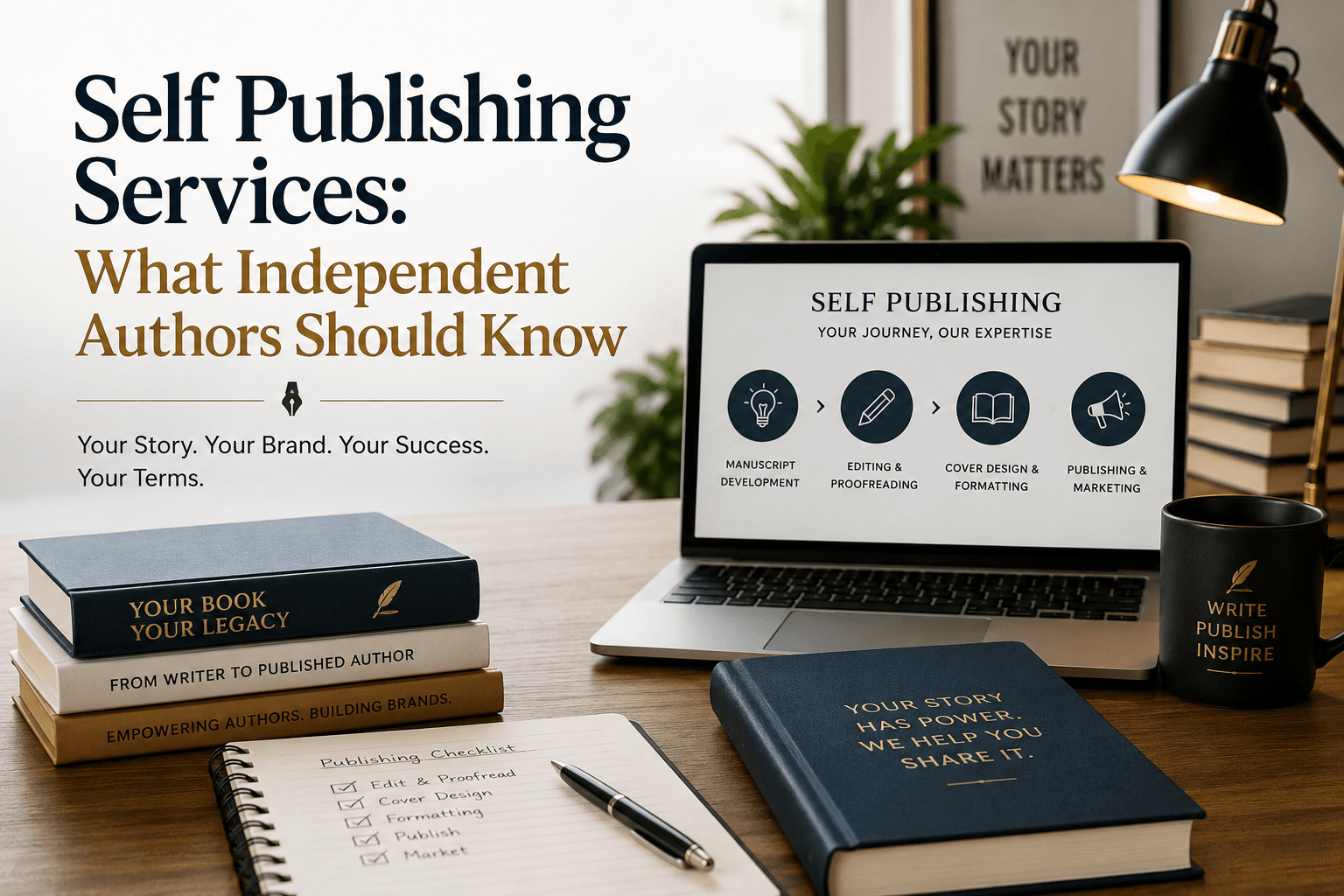
Professional self publishing services are commercial services that help authors prepare and release books without using the full production structure of a traditional publishing house. They may include manuscript assessment, editing, cover design, interior formatting, eBook conversion, account setup, printing, and distribution.
The purpose of professional self publishing services is to supply specialist support while the author continues to direct the publication. The precise relationship depends on the service agreement. Some providers complete only one stage, such as editing or cover design, while others coordinate the book from manuscript review to retailer submission.
Overview
Self publishing gives an author a direct role in editorial, production, pricing, and distribution decisions. Digital publishing platforms make this possible by allowing a rights holder to submit a book without first selling the work to a conventional publishing company.
Amazon states that Kindle Direct Publishing supports eBooks, paperbacks, and hardcover books and gives publishers direct access to their Amazon book records. (Amazon KDP publishing guidance) Other services, including IngramSpark, provide print and digital distribution through networks that reach online retailers, bookstores, libraries, and educational institutions. (IngramSpark distribution guidance)
An author can manage many of these tasks independently. Professional self publishing services become relevant when the author wants editorial expertise, production knowledge, technical preparation, or coordinated project management.
Services Commonly Included
A full publishing service may contain several separate forms of work:
- Editorial assessment and manuscript planning
- Copy editing, line editing, or proofreading
- Cover design for print and digital editions
- Interior formatting and typesetting
- eBook conversion and file validation
- Publishing account and metadata support
- Printing and distribution preparation
- Launch materials or marketing support
These services are related, but they are not interchangeable. Editing changes the quality and consistency of the text. Design determines how the book is presented. Formatting prepares the interior for a particular edition. Distribution makes the completed edition available through selected sales channels.
Editorial Assessment and Editing
Editorial work usually begins with an evaluation of the manuscript. The evaluation may consider structure, organization, pacing, clarity, consistency, audience, and the amount of revision required before production.
Different editing levels serve different purposes. Developmental editing addresses the book as a whole. Line editing focuses on expression, flow, and sentence quality. Copy editing corrects grammar, usage, accuracy, and consistency. Proofreading is the final review of text after editing and often after layout.
A service agreement should identify which level of editing is included. The word editing by itself does not establish whether the provider will revise structure, refine sentences, correct mechanical errors, or perform only a final proofread.
The author's voice remains an important editorial consideration. A professional editor improves clarity and consistency without making every author sound the same.
Cover Design
A book cover performs both identification and marketing functions. It presents the title, author name, and visual character of the book while also meeting the technical requirements of the intended format.
An eBook normally requires a front cover image. A paperback or hardcover edition requires a complete print cover that can include the back cover, spine, barcode area, and bleed. Its measurements depend on trim size, binding, paper type, and final page count.
Cover design should therefore begin with the genre and intended readership, but print dimensions should be finalized only after the interior file is complete. A change in page count can change spine width and require a revised print cover.

Interior Formatting and eBook Conversion
Interior formatting organizes the visible pages of a print book. It includes trim size, margins, typefaces, paragraph styles, chapter openings, headers, footers, page numbers, image placement, and front and back matter.
An eBook uses a different reading system. Most eBooks use reflowable text that adjusts to the reader's device and selected font size. Complex books may require more specialized treatment. Amazon accepts several manuscript formats and advises publishers to preview converted files before publication. (Amazon KDP manuscript format guidance)
For this reason, one print PDF cannot automatically serve as a professional eBook. Each edition should be prepared and checked for the environment in which it will be read.
Metadata and Publishing Information
Metadata is the descriptive information connected with a book. It commonly includes the title, subtitle, author name, contributor names, description, categories, keywords, language, publishing rights, territories, and price.
Accurate metadata helps retailers identify and display the book correctly. It should match the information printed on the cover and title page. Inconsistent titles, contributor names, or edition details can delay publication and create duplicate or incorrect retailer records.
Keyword and category research can improve discoverability, but metadata does not guarantee sales. It helps a suitable reader find and understand the book. The quality of the book, its audience, reviews, availability, and marketing activity also influence performance.
Account Setup and Platform Submission
Publishing platforms require account information before a book can be released and royalties can be paid. The account may contain legal identity, banking, tax, and contact information in addition to manuscript and cover files.
When a company is providing publishing assistance rather than acquiring publishing rights, the author usually benefits from retaining direct control of the publishing account. A service provider can prepare the files and guide the submission without becoming the permanent owner of the account. Amazon allows an existing Amazon account to be used for KDP and provides a separate account setup process for publishers. (Amazon KDP account guidance)
Passwords, verification codes, bank details, and tax information should be handled carefully. The service agreement should explain how access is managed and who remains responsible for the account after the project is complete.
Printing Options
Print on demand is a production method in which copies are printed after an order is placed. It reduces the need to purchase and store a large quantity of books before sales begin. The unit cost can be higher than a large production run, but the financial and storage risk is usually lower.
Bulk printing produces a selected number of copies in advance. It may provide a lower unit cost for a sufficiently large order, but it requires payment, storage, shipping, and inventory planning before the books are sold.
Some professional self publishing services coordinate both methods. The suitable choice depends on expected demand, format, color requirements, sales channels, budget, and the author's ability to store and distribute physical copies.
Distribution
Distribution determines where a book can be ordered. It is separate from marketing. A title may be technically available through a retailer or wholesaler without receiving active promotion or guaranteed shelf placement.
Amazon KDP gives publishers access to Amazon marketplaces and offers options for Kindle and print editions. IngramSpark describes a wider network that includes online stores, independent bookstores, chain stores, libraries, universities, and eBook retailers. (IngramSpark global distribution information)
Platform availability can depend on format, territory, pricing, wholesale terms, exclusivity choices, and the files supplied. For example, enrollment of an eBook in KDP Select creates an Amazon exclusivity requirement for that digital edition during the enrollment period. (Amazon KDP publishing guidance)
A publishing plan should identify the intended platforms and distinguish direct retailer submission from distribution through an intermediary.
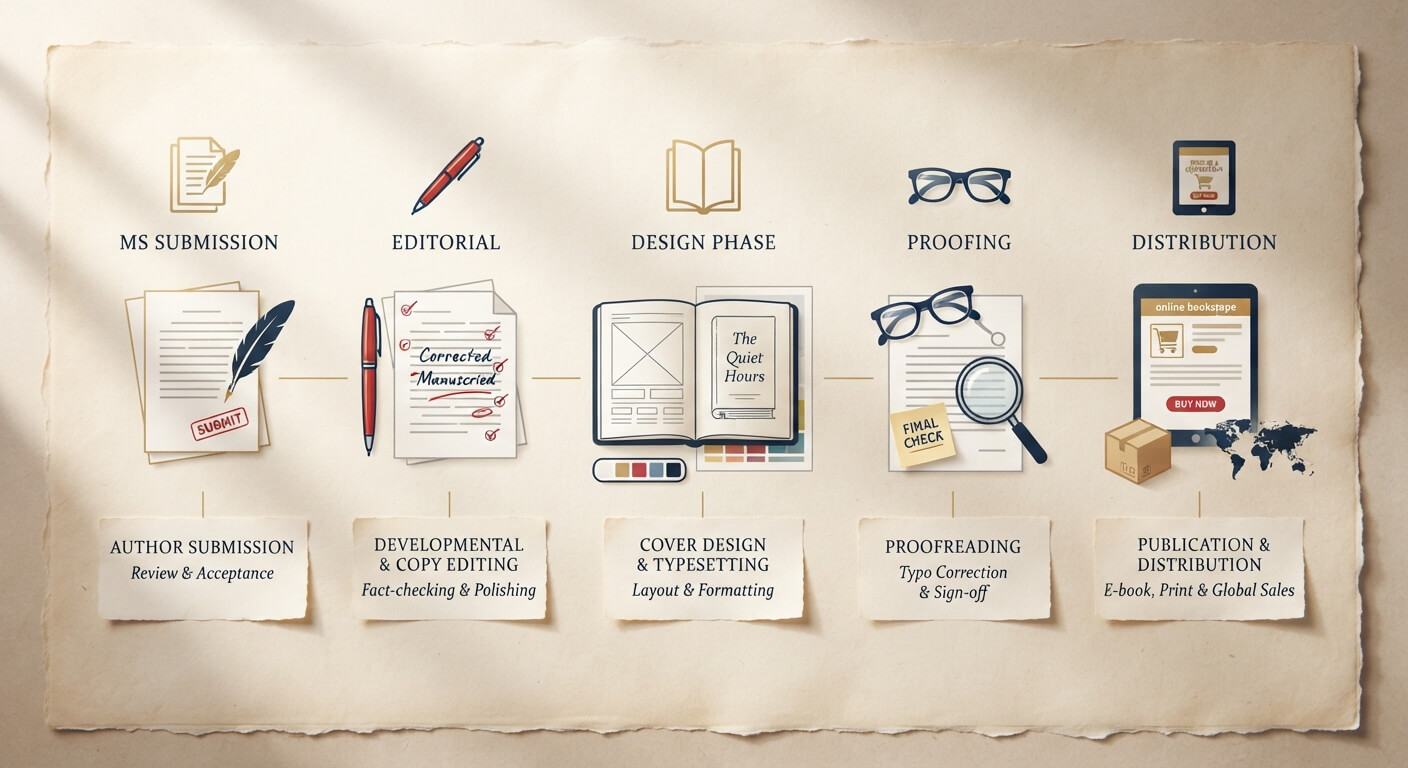
A Typical Publishing Process
Although projects differ, a coordinated service commonly follows this sequence:
- The author submits the manuscript and explains the intended audience, format, and publishing goals
- The provider evaluates the manuscript and defines the required editorial and production work
- The manuscript is edited and returned for author review or approval
- The cover and interior are designed for the selected print and digital editions
- Proof files are reviewed and corrected before final approval
- Metadata, pricing, account information, and distribution choices are prepared
- Final files are submitted to the selected publishing platforms
- The live retailer pages and physical proofs are checked after publication
The author should receive clear approval points throughout the process. A file should not be treated as final merely because it has been uploaded successfully. Editorial approval, visual review, platform validation, and a print proof address different types of error.
Rights and Royalties
The relationship between an author and a service provider differs from the relationship between an author and a traditional publisher. A service provider is paid to perform defined work. A traditional publisher normally acquires specified publishing rights and takes responsibility for publication under the terms of a contract.
Self publishing platforms can allow the author to retain rights. Amazon states that KDP publishers keep the rights to their books, subject to the platform agreement and any optional program restrictions. (Amazon KDP publishing guidance)
The author's contract with a service company should separately state:
- Who owns the manuscript, cover, illustrations, and production files
- Who controls the publishing accounts
- Which bank account receives platform payments
- Whether the provider receives a fixed fee, a royalty share, or another payment
- Which territories, formats, and platforms are included
- What happens to files and accounts when the agreement ends
Royalty percentages vary by platform, format, list price, printing cost, territory, and program. Amazon maintains separate guidance for digital and print royalty calculations. (Amazon KDP royalty guidance) A provider should not describe gross sales, platform royalties, and the author's net payment as though they were the same figure.
Costs and Timelines
The cost of professional self publishing services varies because books require different amounts of work. Relevant factors include manuscript length, editorial condition, genre, number of illustrations, complexity of layout, number of editions, print specifications, distribution plan, and revision requirements.
A useful quotation should separate the services being purchased and identify what is not included. It should also explain the number of revision rounds, payment schedule, expected deliverables, ownership of source files, and any charges that can arise after approval.
Publishing time also varies. A finished and carefully edited novel can move through production faster than an illustrated book that still requires major revision. The project schedule should include time for author review, corrections, proof approval, and platform processing rather than presenting publication as a single immediate action.
Evaluating a Service Provider
An author comparing professional self publishing services should examine the proposed process as carefully as the price. Useful questions include:
- Which level of editing is included
- Who performs the editing, design, and formatting
- Which files will be delivered to the author
- How many revision rounds are included
- Who owns the publishing account and receives royalties
- Which platforms and territories are included
- Whether printing means print on demand, bulk production, or both
- How costs, refunds, delays, and termination are handled
- Whether sales or marketing claims are supported by verifiable evidence
- How the provider protects manuscripts and personal information
Real portfolio samples, written terms, clear communication, and itemized deliverables are more useful than general claims. Review counts, customer ratings, awards, and testimonials should be published only when they can be verified.

Fleck Publisher Service Model
The proposed Fleck Publisher service model combines project guidance with editorial and production support. Its stated scope includes a dedicated publishing specialist, manuscript editing, cover design, interior preparation, print production, and distribution assistance.
Within this model, Fleck Publisher acts as a service provider for an independent author rather than as the owner of the author's work. The author can retain creative control and publishing rights while using specialists to complete selected tasks.
The final agreement should identify the exact service level, formats, retailers, timetable, revisions, fees, account arrangement, and deliverable files. Any statement about review totals, years of experience, turnaround time, discounts, guarantees, or retailer access should be confirmed before it appears on a public website.
Summary
Professional self publishing services bring editorial, design, production, and distribution skills into an author controlled publishing process. Their value depends on a clearly defined scope, accurate platform preparation, transparent costs, secure account handling, and written protection of the author's rights. A suitable provider should make the publishing process easier to understand while leaving the author fully informed about each decision and deliverable.